Studying in Canada: Key Advantages for Chinese Students (2026 Policy Overview)
Leading visa approval rates, undergraduate quota protections, post-graduation work permits, and scholarship preferences — an overview of Canada's advantages for Chinese students.

Visa Approval: Chinese Students Lead
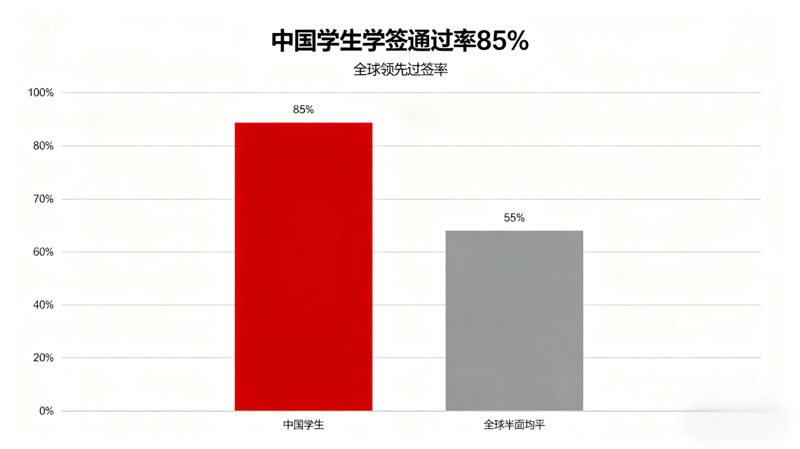
IRCC data shows Chinese undergraduate students achieve a first-application study-permit approval rate of 75%–90%, well above the global average. Processing takes 1–2 months, with 2026 reforms streamlining documentation. From September 2025, applicants must demonstrate tuition plus CAD 10,000/year in living expenses.
2026 Policy Highlights: Undergraduate-Friendly
Canada plans to issue 155,000 study permits in 2026, with undergraduates as the core quota group and public institutions receiving priority. Over 80% of Canadian public universities accept Chinese gaokao scores for direct admission. The Post-Graduation Work Permit (PGWP) allows up to 3 years of open work after graduation, with permanent residency (PR) available after 1 year of Canadian work experience.

Scholarships: Queen's University, University of Calgary, and others offer international-student scholarships; gaokao 650+ or all-A huikao students may qualify for tuition waivers. STEM students may additionally access a government research subsidy of CAD 15,000/year.
Safety and Cost

Canada is consistently ranked among the world's most liveable countries. Undergraduate tuition averages CAD 15,000–30,000/year (approx. RMB 80,000–160,000); total costs of RMB 150,000–250,000/year represent roughly 70% of U.S. and 75% of U.K. equivalents.
(Data sourced from New Oriental's "2026 Canada Study Policy Analysis" and EIC's "China Undergraduate Study Abroad White Paper (Canada)," as of April 2026. Official policy follows IRCC announcements.)